
Video installations
︎︎︎︎︎︎
EX NIHILO

video#1 :: 03mn16-loop
video#2 :: 05mn52-loop
video#3 :: 02mn39-loop
video#4 :: 04mn43-loop
video#5 :: 03mn27-loop
video#6 :: 03mn59-loop
video#7 :: 03mn46-loop
︎
Genesis :: speakers playing three soundtracks & audio text [12mn-loop]
Ex Nihilo is a video installation that offers, by way of metaphor, a mirrored space instituting its will to jouissance, paying tribute to the power of the image, which always speaks of itself and cheerfully mocks appearances, without losing sight of the smile that gives rise to the grimace. An orgasm that laughs, sometimes weeps, yet fails to bring lasting relief, like an eternal recommencement in which silence and tension carve out a condition turned to fiction before the impertinence of a time that exceeds us.
A journey to the end of breath springing from a stratum of mother-of-pearl that does not run dry, a woman, seven escapes under a gaze that turns into a caress to create an encounter on the edge of the ineffable — between nature and culture. Tides or waves... Sisyphus and a veil cast over a reality imprinted with uncertainty — for one never takes flight except against the wind.
︎︎︎︎︎︎
FLAT SPOT
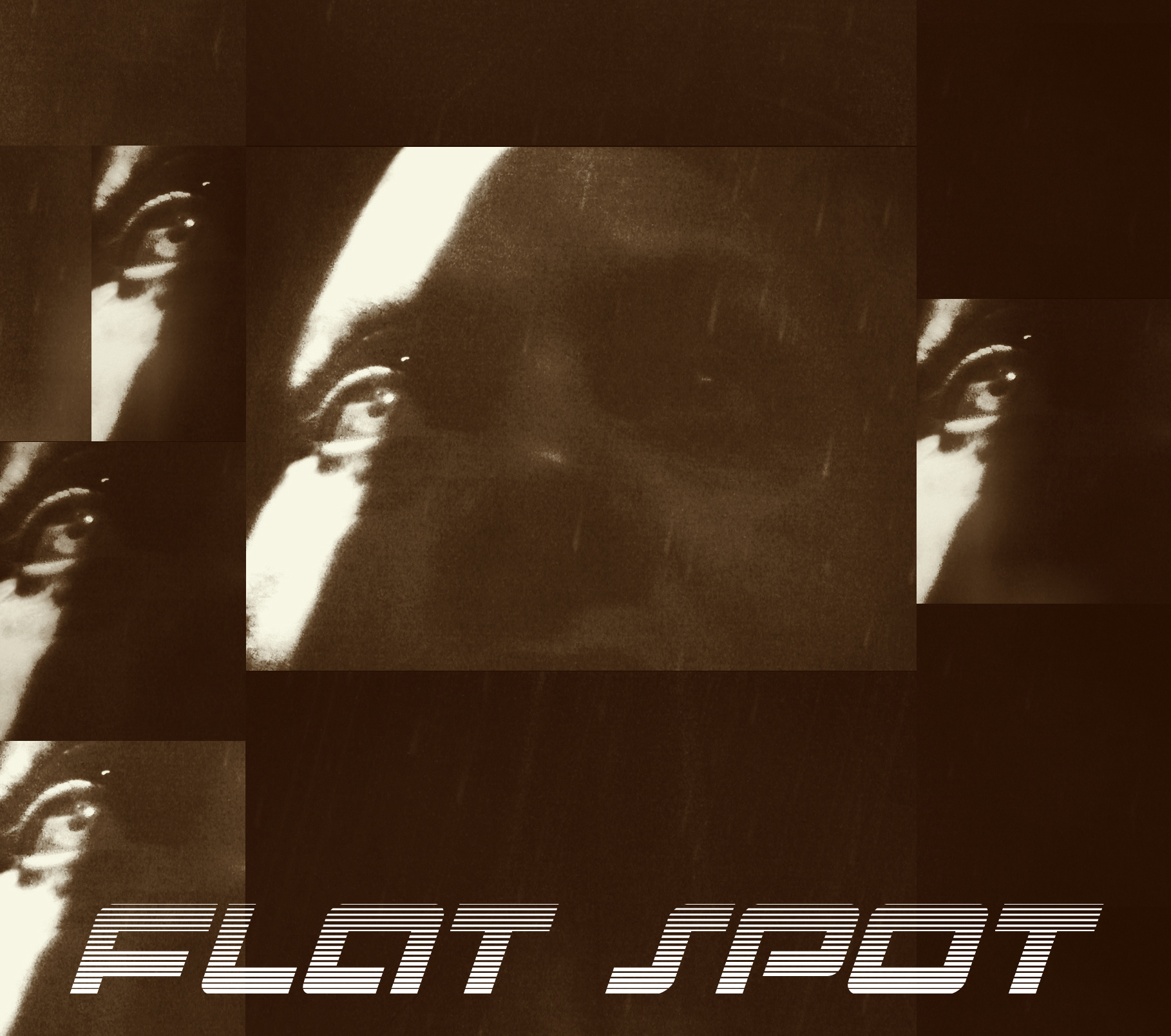
Interactive video installation [5 screens with presence detectors/PIR sensors], 2015.
video#1 :: 01mn46-loop
video#2 :: 01mn43-loop
video#3 :: 04mn48-loop
video#4 :: 02mn16-loop
video#5 :: 01mn29-loop


Flat Spot is a video installation that explores the absence of a presence, as understood by Derrida, and presents itself as a place of convergence between memories and hope, to abstract oneself from reality and its contingencies, carried along by traces — as in a dream where alterity, highly idealised, arises in reference to the self, in an impulse whose dramaturgical devices reveal the visceral need to be considered in one’s singularity even as the social bond grows ever more precarious.
An imprint born of an encounter at the deepest point of lack which, stirred by envy in its delicate alteration, "its ephemeral destiny" [Freud], remains suspended, at once "the closest to and furthest from oneself" [Augustine]. Beyond language, a silence prevails with evanescent promises in filigree, and with the sole dull, persistent certainty that a presence, in order to express itself, must first consent to its own absence.
︎︎︎︎︎︎
F.M.T. — FUCK ME TENDER

Immersive video & installation [2 screens + prose printed on a wall panel], 2015.
video#1 :: 10mn-loop
video#2 :: 10mn-loop
︎
PRESS RELEASE — VIVOEQUIDEM GALLERY
There is no doubt that at the beginning of the 21st century, we are full of incertitude: facing economic, political, social, spiritual, technological and ecological crises. The world is in the process of profound and rapid change where all human structures collide. A change of cycle, a change of era, or a change of air? It is quite obvious that today, people have no peace of body and no peace of mind.
VivoEquidem has used this phenomenon as a basis for the group exhibition J’ai mal ! J’ai peur ! [from 26 September 2015 to 20 February 2016], where participants are invited to experiment in their own particular way with two main themes, fear and/or suffering. The idea of the project is to capture a moment, like a time capsule, which, in the near or distant future, will help us recognise and understand how pain and fear precipitated, chemically speaking, in a world pushing forward with inexorable entropy.
︎︎︎︎︎︎
ALDI’S CHICKENS IN LOVE
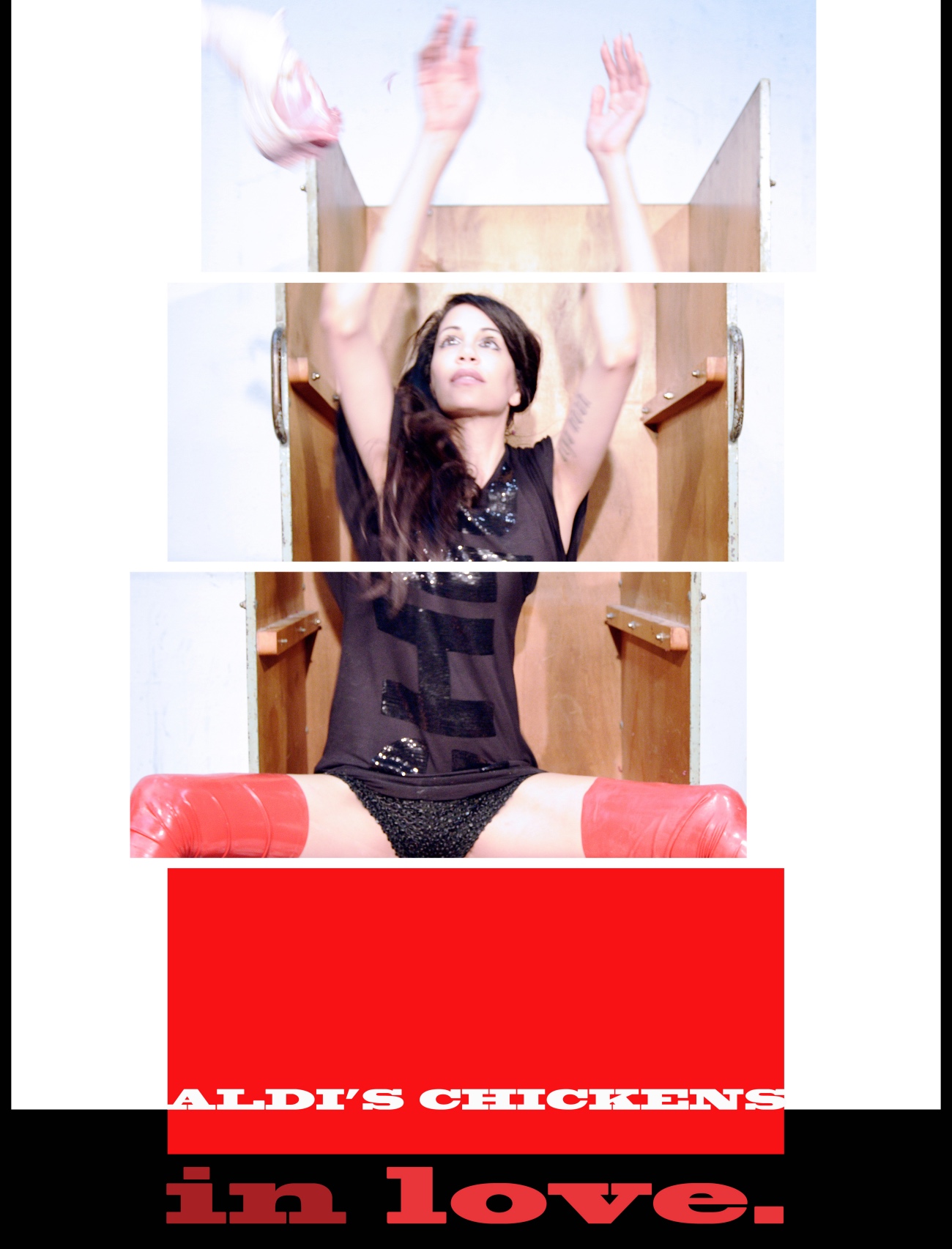
Video 2mn40-loop, 2012.
ISAN 0000-0003-5E73-0000-K-0000-0000-E
︎︎︎︎︎︎
AS CLEAN AS A PUSSY

Video 2mn10-loop, 2011.
ISAN 0000-0003-007A-0000-9-0000-0000-A
︎︎︎︎︎︎
IN NUTS WE TRUST
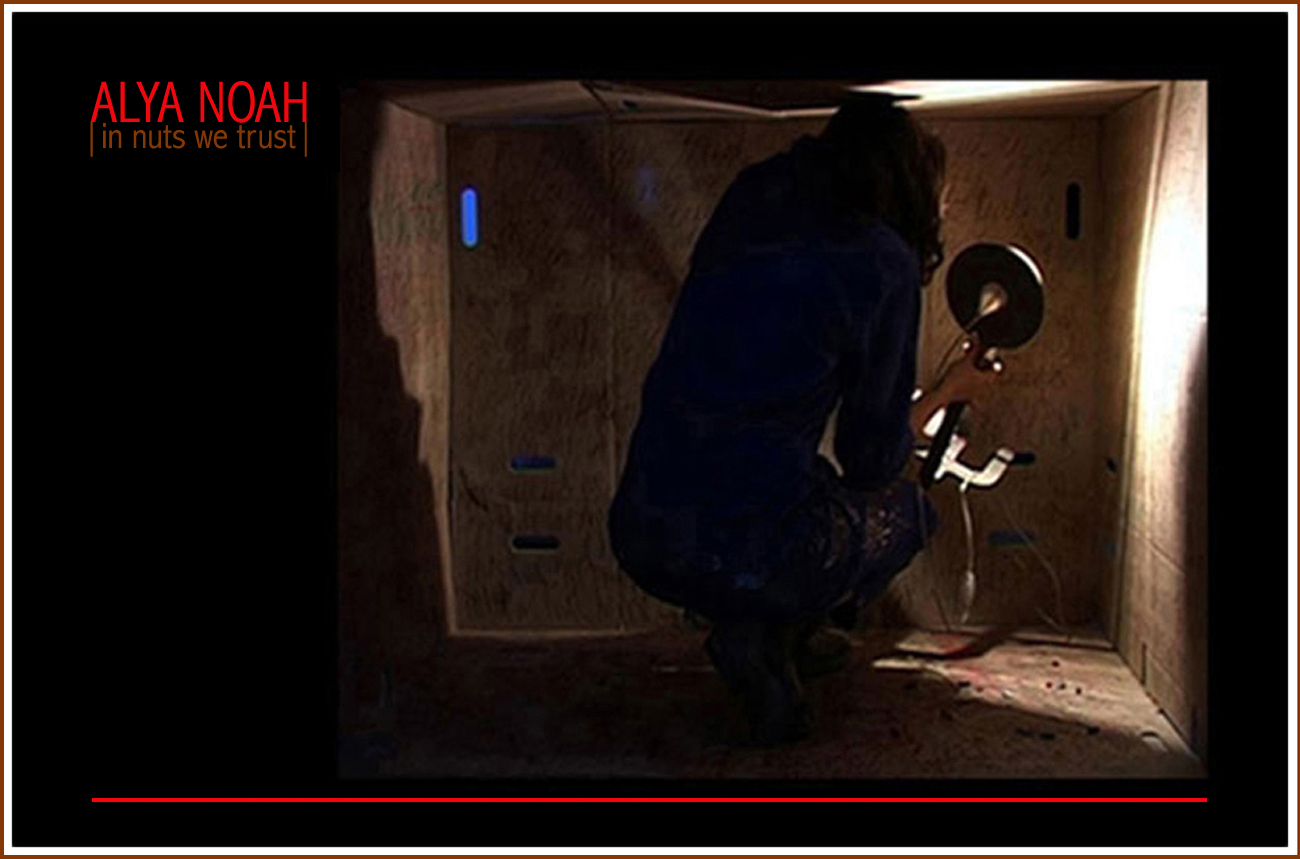
Video 54mn-loop & performance, 2011
ISAN 0000-0002-CBBF-0000-N-0000-0000-5
In nuts we trust is a video installation featuring Alya Noah, dressed in overalls, locked in a cardboard box, scribbling "in nuts we trust" in chalk on the walls, which she gradually covers. Lit only by a small backup lamp, she busies herself completing her work by an ontological act of impregnation attempting to create an allegory between marking a territory and taking a position.
Alya Noah, through the simplicity of a spontaneous intentionality, asserts her elementary thoughts, as opposed to the sophistication of our postmodern world, she returns to a primitive origin: by analogy to cave paintings, the walls of the box follow those of caverns. More than mere words, in a bustling frenzy of the moment, she paradoxically questions the identity of the work by giving rise to doubt of its bedrock: referring to it in a reflexive, dialectical manner, does the work maintain any significance or does it mainly contribute to ensuring its own survival? Furthermore, is the artist's imprint sufficient to secure her influence over an external reality — one thereby transformed into an abstract entity, sublimated beyond its materiality and prosaic appearance — creating distance from prejudice and conventional thinking?
In nuts we trust is the transition from ritualisation to idealisation of an aesthetic gesture constructed in relation to a world supporting the realisation of trivia — a gesture that, included in a process of autonomous creation, injects sense where once inconsistency and confusion reigned, composing, in addition, a score where choreography and harmony come to life in the dynamic of the movement. Thus, Alya Noah, evolving beyond the usual time constraints, frees herself from the grip of the alienating everyday life and projects herself into an artificial space inducing a new temporality, ephemeral indeed, but not precarious any more. While casting an ironic eye on her role as an artist — through the externalisation of her words, the obsessive and derisory character of her acts — she expresses a singularity, leaving the trace of a subjectivity as a pledge towards legitimacy.
︎︎︎︎︎︎
LILLY ROSE IS A LILLIPUT

Video installation, 2011.
9 videos :: 11mn-loop
ISAN 0000-0002-BF5D-0000-D-0000-0000-Z
︎
Soundtrack :: The murmurs
Lilly Rose is a Lilliput is a video installation in the form of an elongated black wooden monolith, suspended on the wall. Its façade opens onto nine doors. Behind each one, a smartphone loops a video clip suggesting the evanescent world of childhood. Thus, against an opaque black background that merges with the structure, a single presence appears on each screen: Lilly Rose, dressed in pale clothing, her feet bandaged, tirelessly playing out a whimsical scene, "la fleur en col". The spectator actively participates in the exploratory process as much as in the cognitive elaboration necessary for the reconstruction of successive fragments into a whole: he leans in, manipulates the installation, interacts with the physicality of the art piece and experiences the game-like quality of the system by discovering sound and images. As in Alice in Wonderland, transported to the heart of the action, he retains control of the situation and determines his field of vision as he sees fit, opening or closing the doors to place whichever scene he chooses before his eyes.
Lilly Rose’s character, confronted throughout the sequences with the banality of daily life, the sacralisation of nothingness, casts the viewer back upon the sensation of his own fragility. Introducing herself as a lilliputian, admittedly superficial but also full of poetry, Lilly Rose embodies the derisory splendour of the frail young girl, a substitute for the woman infantilised by a tacitly conservative social body. Extracted from tangible reality, absolved of responsibility for her actions, without any real self-consciousness, she attracts notice, asserts herself apart from any form of seduction and lays bare her laughable humanity while vanishing into the role of the burlesque character so often reserved for men.
The miniature video, combining new technology with a contemporary dimension, tends to expand the field of the real: by granting the image a non-standardised status, it allows Lilly Rose to occupy the place fully, exceeding the condition of a dematerialised representation, with no further reference to any fantasmatic or imaginary world. Reality thus seizes an omniscient point of view, beyond any symbolic space, with no notion of an off-screen space or a specific temporality; the character's material environment and mental framework are those of the installation itself. In this way, Lilly Rose, estranged from her own purpose, like a physical object — a small, gesticulating, bran-stuffed doll within reach — invites the observer to contemplate her directly. Confined within her microcosm, cloistered behind doors that delimit a closed intrapsychic universe, the almost obsessive, repetitive gesture she employs frees her from the weight of solitude and the torments of captivity without thereby dispelling her innocence. She remains, moreover, split into nine fragments.
︎︎︎︎︎︎
WILL YOU MARRY ME?

Video installation, 2010.
7 videos :: 70mn-loop [7x10mn-loop]
ISAN 0000-0002-8C46-0000-A-0000-0000-7
The installation consists of 7 flat screens, large format, projecting simultaneously 7 videos on loop, with initial durations of 10 minutes each. A visual and auditory presence confronts the spectator, free in his mobility, who wanders in front of a female body perceived in action, a sort of carnal envelope fragmented into 7 parts, with 7 tight shots seeking to provoke a frontal engagement with the image and to elicit, where appropriate, an experience of a libidinal nature.
Will you marry me confronts acts apparently intimate with images broadcast in close-ups and sequence shots with their own intrinsic narratives. The observer is immersed in a woman’s story within her physical intimacy, at the confines of her loneliness. The lack of context and decor allows one to freely imagine her appearance or her surroundings. Together, the close framings, minimalist and unadorned, are plainly sufficient: the gestures express themselves with their literalism; they become universes unto themselves, the orchestration of an intentionality verging on the scopophilic. The installation constructs no further temporality through editing. Each shot is offered to the viewer's gaze in its real duration and its entirety; the off-screen space also contributes to the construction of an artifice — a unity gathering the parts into a totality.
The device defines a contemporary woman, amputated from her individuality, roughly handled by schizophrenic discourses on beauty and conformity until the outbreak of a paroxysmal state: the disillusionment. The alienation is, moreover, reinforced by the apparatus's distribution across several video monitors. Body parts are disconnected from each other. In this way, this woman overexposed, deformed or even mutilated in her contour lines by her exacerbated craving to be incorporated by an idealised [if not fantasised] third party; doesn’t she feel trapped by her willingness to seduce? She cannot be considered in her finitude and is limited to a series of impersonal stimuli; deprived of any materiality, she lives through the instrumentalisation of her gendered nature, without discernment but with determination. The ambiguity appears then: the stereotypical woman, annihilated in her flesh, mutates and gives way to the advent of a physical woman, limitlessly fetishised, beyond any cultural reference. She remains multiple, removed from the world, encapsulated in a solitude that is stirred up by the pressures of a consumerist society pushing the individual to focus on oneself, to indulge in a narcissism inciting an unfailing negation of its own essence to the very pinnacle of the culture of the self.
This installation thus rests on an act of monstration evoking the paradoxical relationship between an exhibited body and a suggested psyche. Intimacy, unveiled, is reinforced in the process of the shots. The viewer, as close as possible to the gestural temporality of the character, is overwhelmed by a feeling of unease, or at least stupor. Submitted to his own alienating structure through his visceral need to infuse signification where only the image asserts itself; is he not, therefore, participating in the dramaturgy of narration? The cellophane wrapping, evocative of a dream, like a promise of the future, sends us back to the poeticised representation of this woman: wrapped, ready to be consumed, ingested and digested, she offers herself in a desperate attempt to answer as much to her need to please as to her necessity to be loved.But this invasive desire to be and to appear withers and her body parts, at first erotic, turn out to be repellent and ridiculous, absorbed by the excess and escalation of the transformation.